
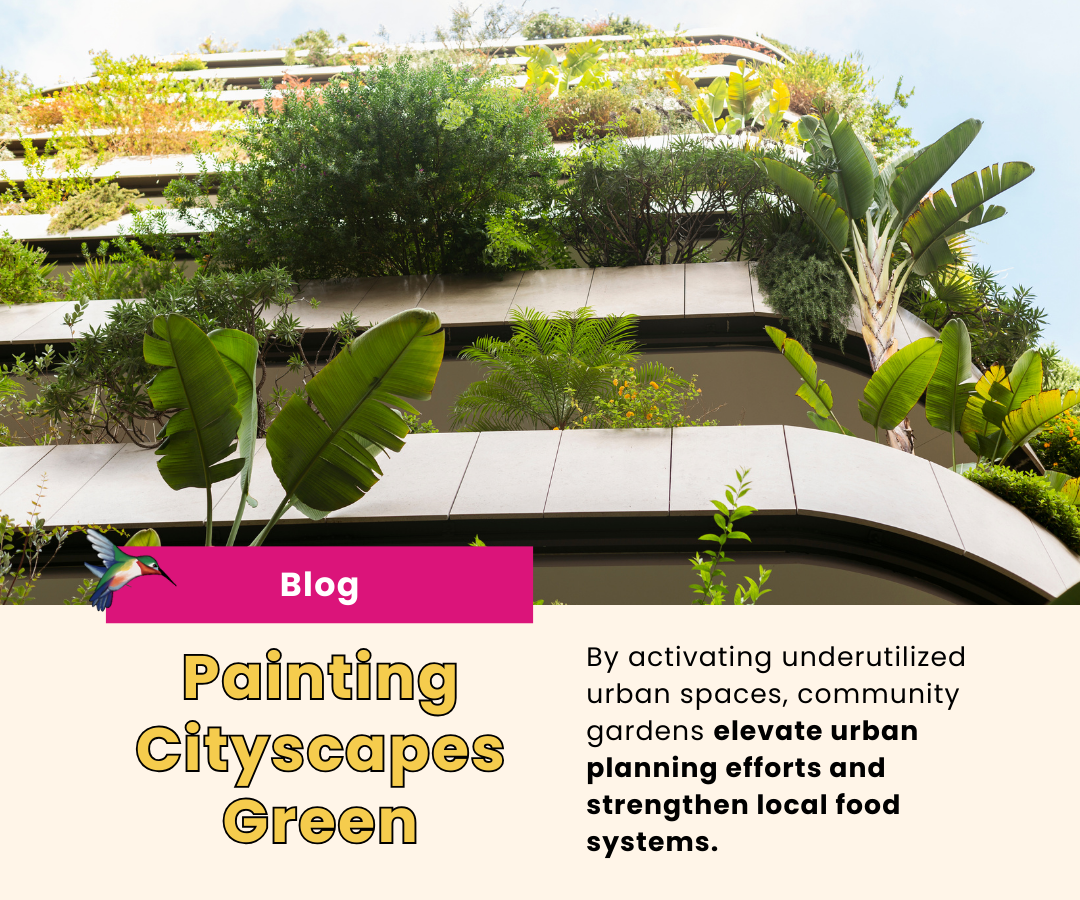
By activating underutilized urban spaces, community gardens elevate urban planning efforts and contribute to strengthening local food systems.
Over half of the world’s population currently resides in urban areas, a trend projected to continue in the coming decades. Rapid urbanization creates greater distance between people and the sources of their food. The growing physical distance from agriculture can affect how aware individuals are of the origins of their food and the farming methods that support these systems.
Incorporating environmental sustainability and health equity into urban planning is particularly important for lower-income communities who disproportionately experience the consequences of climate change. Placemaking is a strategy to establish resilience and a sense of collaboration within a community through empowerment and the construction of positive, communal resources.

Photo Credit: Angelina Sharma, Garden Coordinator, Community Garden Roots.
Placemaking initiatives in urban communities can support shifts towards a more sustainable way of living by emphasizing the establishment of inclusive, communal, and cultural spaces. Green interventions such as community gardens, have the power to challenge the notion that urban density and nature are inherently separate. Placemaking fosters a sense of community by providing venues for outdoor events, such as farmers’ markets, yoga classes, or neighbourhood gatherings.
Post-pandemic reflections have revealed that communal green spaces allow for collaboration and social interaction while adhering to physical distancing guidelines.

Photo Credit: Angelina Sharma, Project Coordinator, Community Garden Roots.
Continued urbanization is expected to cause cities to be epicenters for communicable diseases. By increasing outdoor spaces for recreation and relaxation, overcrowding indoors is reduced, and can lessen the risk of disease transmission, especially during the warmer months.
Through such placemaking endeavours, urban landscapes can be activated, promoting a sense of pride and ownership among residents while nurturing a stronger sense of community cohesion.
When green spaces can exist amidst bustling urbanized areas, an opportunity arises for increased connection, wellbeing, and value for the planet!
About the author
Melody Choi is an alumni of Simon Fraser University, with a major in Communications and a minor in Health Sciences. She participated in the PHABC RiseUp! Volunteer Program and completed her placement with Community Garden Roots (formerly known as Can You Dig It!). These blog posts were written to showcase the diverse benefits that community gardens offer,
References
Croshaw, R. W., & Freund, C. (2023). Incorporating urban ecosystem services into policy: A review. People and Nature, 5(4), 920–933. https://doi.org/10.1002/pan3.10423
Organisation for Economic Co-operation and Development. (1999). The price of climate change: Weather-related disasters, costs and policy options. https://www.oecd.org/env/cc/2502872.pdf
Placemaking Canada. (2023, July 18). Indigenous kitchen garden: Learning and growing in the city. https://placemakingcommunity.ca/blog/indigenous-kitchen-garden-learning-and-growing-in-the-city/
Project for Public Spaces. (n.d.). What is placemaking? https://www.pps.org/article/what-is-placemaking#:~:text=It%20is%20centered%20around%20observing,common%20vision%20for%20that%20place
World Health Organization. (n.d.). Urban health. https://www.who.int/news-room/fact-sheets/detail/urban-health
Zhang, Y., & Li, F. (2024). Understanding urban biodiversity through spatial analysis. Landscape Ecology. https://doi.org/10.1007/s10980-024-01833-z